Archives: Posts

High speeds with the moteus controller

Someone contacted me not too long ago who wanted to use the moteus controller, but wasn’t sure if it would be able to hit their target mechanical velocity of 6000rpm. I honestly wasn’t either, so I tested it. After a quick firmware fix, the devkit motor when run at 34V seems to be able to do it no problem.

It should be noted that the current firmware assumes you are within a thousand or so revolutions of 0. You can exceed that pretty quickly running at 120 revolutions per second!
Testing real-life hill operation

In part 1, part 2, and part 3 of this series, I developed a method for keeping the robot balanced on hills in simulation. This is just a short video update demonstrating the results for a variety of gaits on a gentle-ish hill (the slope is around 7 degrees).

Balancing on estimated terrain

Last time, I described my approach for estimating the terrain under the robot based on the inertial measurement unit and proprioceptive foot feedback. Now, I’ll cover how that is used to balance.

“R” Frame

First, let me explain the “R” or “robot” frame and how it is used. The frames I’ve discussed in this series so far are the “B” frame, which is rigidly attached to the center of the robot body, the “M” frame, which is located at the center of mass and level with the ground, and the “T” frame, which is under the robot and level with the current terrain.

Estimating terrain slope

Last time I discussed the challenges when operating the mjbots quad A1 on sloped surfaces. While there are a number of possible means of tackling this, the approach I’ve gone with for now is to estimate the slope of the terrain under the robot, and use that to determine how to position the center of mass. Here’ll I’ll cover the estimation part of this solution.

On paper, the quad A1 has plenty of information to estimate the terrain under its feet. Between the IMU with attitude estimator, the proprioceptive feedback from the joints, and the ability to move the feet around, it would be obvious to a human whether the ground under them was sloped or level. The challenge here is to devise an algorithm to do so, despite the noise in the IMU, the fact that the feet are not always on the ground, and that as the robot moves, the terrain under it changes.

Operating on sloped surfaces

Not too long ago, I ran some outdoor experiments, and while piloting the quad A1 around, realized that it wasn’t going to get very far if it was restricted to just flat ground.

Since the control algorithms are completely ignorant of slopes, the center of gravity of the machine can easily get too close to the support polygon when resting, and similarly fails to stay balanced over the support line during the trot gait.

mjbots Monday: New lower prices

One of my goals with mjbots is to make building dynamic robots more accessible to researchers and enthusiasts everywhere. To make that more of a reality, I’m lowering the prices in a big way on the foundational components of brushless robotic systems, the moteus controller and qdd100 servo.

Old New
moteus r4.3 controller $119 $79
moteus r4.3 devkit $199 $159
qdd100 beta $549 $429
qdd100 beta devkit $599 $469

Don’t worry, if you purchased any of these in the last month, you should be getting a coupon in your email equivalent to the difference.

Measuring the pi3hat r4.2 performance

Last time I covered the new software library that I wrote to help use all the features of the pi3hat, in an efficient manner. This time, I’ll cover how I measured the performance of the result, and talk about how it can be integrated into a robotic control system.

pi3hat r4.2 available at mjbots.com

pi3hat r4.2 available at mjbots.com

Test Setup

To check out the timing, I wired up a pi3hat into the quad A1 and used the oscilloscope to probe one of the SPI clocks and CAN bus 1 and 3.

Bringing up the pi3hat r4.2

The pi3hat r4.2, now in the mjbots store, has only minor hardware changes from the r4 and r4.1 versions. What has changed in a bigger way is the firmware, and the software that is available to interface with it. The interface software for the previous versions was tightly coupled to the quad A1s overall codebase, that made it basically impossible to use with without significant rework. So, that rework is what I’ve done with the new libpi3hat library:

New product Monday: pi3hat

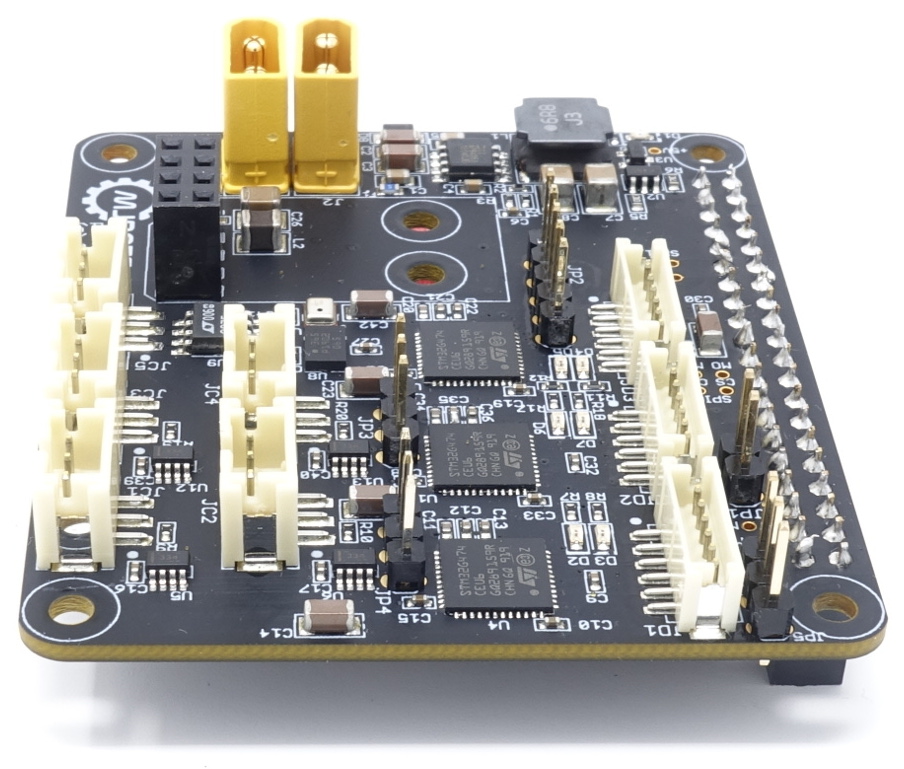
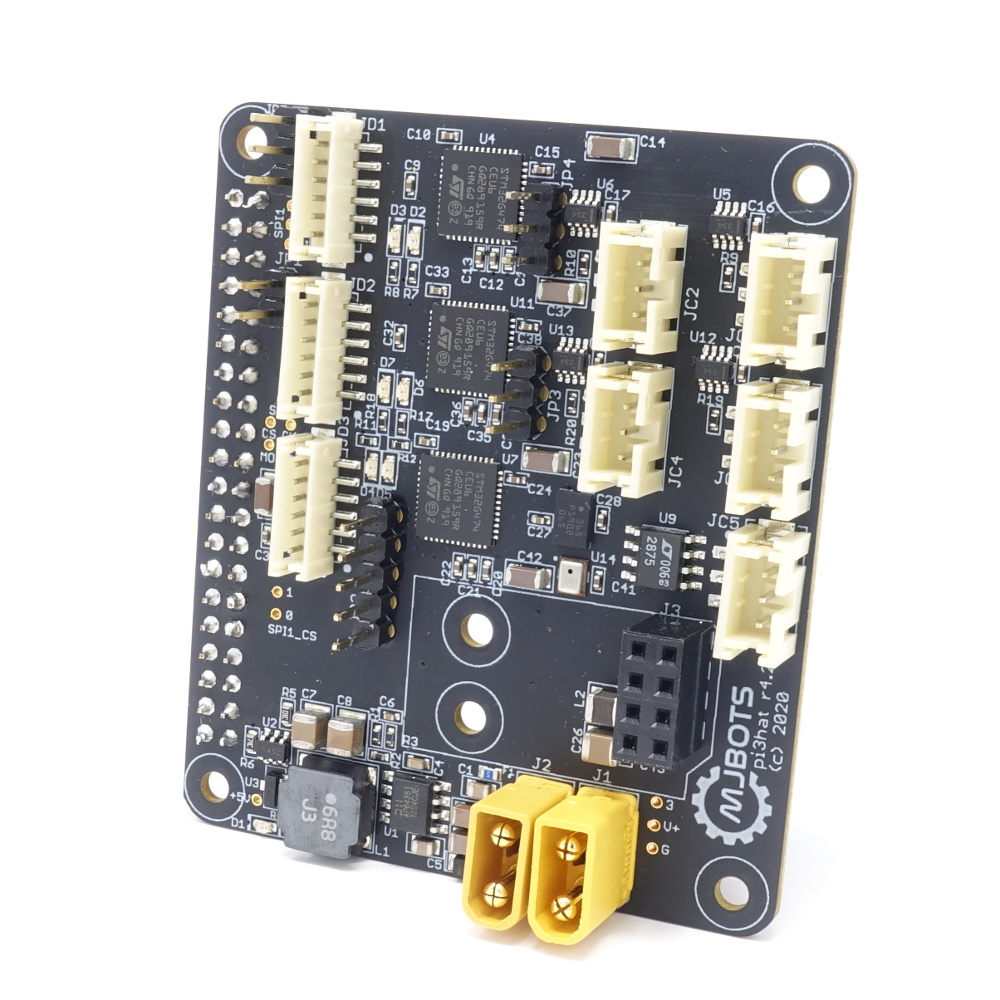
I’ve now got the last custom board from the quad A1 up in the mjbots store for sale, the mjbots pi3 hat for $129.

This board breaks out 4x 5Mbps CAN-FD ports, 1 low speed CAN port, a 1kHz IMU and a port for a nrf24l01. Despite its name, it works just fine with the Rasbperry Pi 4 in addition to the 3b+ I have tested with mostly to date. I also have a new user-space library for interfacing with it that I will document in some upcoming posts. That library makes it pretty easy to use in a variety of applications.

Raspberry Pi 4

Only 1 full year after it was released, I managed to get a Raspberry Pi 4 and test it out in the quad A1. I had been delaying doing so because of reports of thermal issues. The Pi 3B+ already ran a little hot and I didn’t want to have to add active cooling into the robot chassis to get it stable.

It looks like the Raspberry Pi engineers have been hard at work because the newer firmware releases have significantly reduced the overall power consumption and thus the thermal load. In my testing so far it only seems “a little” hotter than the 3b+.