Archives: Posts

Pocket NC windowed machining

When I first acquired my Pocket NC v2-50, I was planning on using it for rapid prototyping of small aluminum parts. I figured with 5 axes, I could do many things with a single setup just clamping from the bottom. However, I was initially thwarted in that plan and had to resort to more creative workholding solutions due to two problems.

First was the vice that came with the Pocket NC. It is serviceable, but provides very little clamping force if you want to hold something that is tall and skinny. For now, while it isn’t ideal, I’m making good progress with the wcubed vise.
Native moteus tools for Windows

To date, all of the development tools for the moteus brushless controller have been available exclusively for Linux based operating systems. I’ve been doing some behind the scenes work, and have gotten to the point where moteus_tool now runs natively on windows and can communicate with moteus controllers using a fdcanusb.

Check out the Windows installer for the latest release:

To make this work, I started from the excellent grailbio/bazel-toolchain, which provides LLVM toolchains for Linux based systems based on the official LLVM pre-compiled binaries. I forked that into mjbots/bazel-toolchain and added Windows support. It isn’t perfect, because the LLVM project only distributes Windows binaries in installer form, and it isn’t possible to extract binaries from them without specialized tooling. So, this version relies on a manually re-packed compressed archive of all the executables.

moteus r4.5

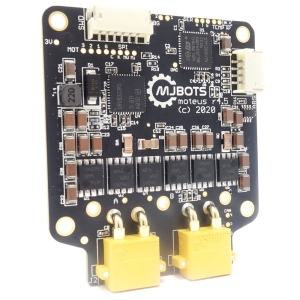
Meet the newest revision of the moteus controller!

Yes, it does look mostly the same as the r4.3 that has been getting a lot of use lately. This revision exists mostly to improve manufacturability, but I snuck in a minor design improvement while at it. Now, the maximum voltage input is rated up to 44V from the 34V of the r4.3! (Note though, that the pi3hat and power_dist still are limited to 34V). Otherwise the new controller is fully electrically, mechanically, and software compatible with the r4.3.

Another quad A1 speed record - 2.5 m/s

In two previous posts (part 1, part 2) I discussed some changes I made to the gait sequencing on the quad A1. Things are working relatively well now, sufficient that I was able to take this compilation video in one sitting without any gait or mechanical failures! I actually took a lot of the outdoor shots from this video in the same session, so things are definitely getting more robust.

Recalibrating the Pocket NC's X/Y home position

This summer I had to send my Pocket NC in for some service, when it came back, I immediately noticed that the X axis homing was very far off, something like 0.01 inches, as I was boring a hole in one side of a part, spinning it around the B axis, then boring a countersink in the other side. The two were very clearly not concentric. I suspect the homing mechanism shifted in transport or something, because the error was very consistent.

Snow day

It’s only October, but the weather is what it is and robots will do what they do!

Walking in semi-rugged terrain

While testing the improved gait sequencing for the quad A1 I got some footage of it traversing a few different types of outdoor semi-rugged terrain.

Tree roots

The first clip shows it walking over some tree roots. In this particular instance, it just uses a high stepping gait, which allows the feet to get on top of the root. The gait sequencing doesn’t handle walking over the taller part of the root very well yet… the robot can get “high centered” on two legs, with the other two flailing in the air.

New compilation commands for moteus

To stay on top of bazel development, and to prepare for some future improvements, I’ve gone ahead and upgraded the moteus firmware build system, rules_mbed to use the new bazel “platforms” toolchain resolution mechanism.

Previously, rules_mbed used the “crosstool_top” bazel mechanism for toolchain configuration. This allowed a single package to contribute a set of C++ toolchains which would be selected based on CPU and compiler. One of the downsides from the rules_mbed perspective, is that it made it difficult to make a build that included both mbed targets and host targets (or anything else non-mbed). rules_mbed worked around this by including a functioning clang host toolchain within it.